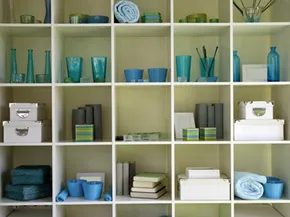
“We have so many books but so little time.” This old saying comes to mind when you look at hundreds of thousands of volumes, most of which you will probably never read again. It is a special pleasure when the shelves are full. But that satisfaction evaporates when you can’t find a certain title, or when the visual noise of wedged book spines gives you a headache. Let’s face it: dense rows of books are terrible for the spines and a nightmare for interior design.
You have to make a choice early on. Are these shelves intended for storage or display? If you want an attractive space, don’t treat bookshelves like a storage container for everything you own. Choose books that matter. Keep shabby paperbacks in the closet. Only the good is visible.
Curate your collection for visual impact
First, think of your books as objects, not just containers of words. If you have a series of similarly bound classics, don’t just arrange them in a row. Mix it up. Stand a little. Stack others. Play with the rhythm until the colors and designs on the spines create a pattern you really like.
If you have a niche collection—for example, vintage picture books or art historical works—let the art lead. You can place a few works cover-out on small easels or lean against the back of the shelf. Open one and to a stunning plate. Change this display volume every time you dust. This keeps the sense of space alive and not static.
Using the rule of thirds to for shelf focus
Once you’ve chosen your book, you need to break the monotony. Designers love the rule of thirds for good reason. It’s a composition tool used in photography, but it works just as well on a bookshelf.
Imagine your shelf is divided into a grid of nine squares – three across and three down. The focal points of your arrangement should be at the intersection of these lines. Place a distinct object in one of these locations. Maybe a small clock. Vase. Framed photo.
You can add height by stacking books horizontally to raise the object, but don’t pack it in. Leave free space around the focal point. The eye needs space to rest there. If you want to add some greenery, stick to artificial plants. Real plants need water and sunlight, both of which are enemies of paper and glue.
Tying the Look Together with color and theme
Repetition creates cohesion. Choose a color and use it on each shelf. Here is a red vase. It has a red frame. The red bowl on the second level. It sounds simple, but it anchors the entire display.
Themes work just as well. If you are displaying photo albums from your summer vacation, put the souvenir on the shelf. Wedding albums get the pair of toasting flutes close by. Use trophies, craft projects or sports equipment as bookends for children’s or grandchildren’s photo books. It tells a story without you having to write a word.
Smart storage solutions for every room
Functional storage doesn’t have to look ugly. It just has to be in the right place.
High and low: Practical Placement
Store fragile items on the highest shelves. Since you don’t reach them often, they are protected from bumps and knocks. Use sturdy baskets for the lower shelves. These are your secret weapon to clutter control.
Throw in:
– Remote controls
– TV Guides
– Unfinished puzzles
– Crafts in progress
– Toys and small games
Baskets are also very useful in the bathroom for storing toiletries. They hide clutter and keep the essentials close at hand.
Managing Kids’ Rooms
There is chaos in the children’s room. The products do not fit neatly into straight lines. Legos, soldiers and irregular toys refuse to stand in rows. Let the baskets do the heavy lifting here.
They enable immediate cleaning. Place the toys in the basket and slide it back onto the shelf. It’s a working system. Use baskets that match the color, style or shape of the room. You can even attach labels to the front. It helps the child learn to read and gives him a clear place for his things.
Store the most frequently used items at the child’s height. Move things you rarely use to the top. It’s all about easy access. If the child can’t get to it, they won’t use it and will place it somewhere else, creating even more chaos.
We’ve only scratched the surface to make the shelves work better and look better. But it’s about more than just books and baskets. How do you deal with empty space? And what about the lighting? This is where real transformation happens.
Practical Office Organization
You don’t need to memorize the Dewey Decimal Classification (DDC) system to make your home office efficient. The goal is simple: group books in a logical, orderly fashion that works for you. If you share the space, divide shelf space into sections for each person to keep things tidy.
Start by separating books into fiction, nonfiction, and reference. For a vast collection, consider using the DDC system, but the current version is complex. Instead, use a method that makes sense for your workflow. Place frequently used books within easy reach. Store rarely needed items on high, low, or distant shelves. Keep reference books like dictionaries and thesauruses in a handy spot.
Stylish Shelf Arrangements
Use tips from living room design to create an attractive arrangement. Define where each subject begins or ends. Don’t pack shelves to the brim. Leave gaps between subjects. Place a related item in the space to mark the boundary.
Use a polished geode as a bookend for mineral books. Display an antique camera or a trio of lenses at the start of a photography section. If shelves double as storage, use uniform or decorative containers. Hold paperclips, pens, and envelopes in these containers. Cluster them together as a focal point.
Now take everything off the shelves. Start over using these tips. You can find more advice online. Happy shelving.
How Libraries Classify Books
Most libraries use either the Dewey Decimal Classification (DDC) or Library of Congress Classification (LCC). The Dewey system was created by Melvil Dewey in 1873. It starts with 10 broad areas of knowledge. Numbers range from 000 for generalities to 900 for geography, history, and biography. Each class has 10 subclasses. These divide further for detailed categorization.
The Library of Congress system was developed by Charles A. Cutter in the same era. It uses 21 classes of knowledge. Each class is designated by a letter. Subclasses and topics use letters and numbers. The LCC is popular in academic libraries.
Bookstores group books informally by interest or subject. This approach is less rigid than library systems. It allows for more flexible organization.
Sources
- Ahearn, Allen and Patricia. Book Collecting 2000: A Comprehensive Guide. New York: G.P. Putnam’s Sons, 2000.
- Better Homes and Gardens. 301 Stylish Storage Ideas. Des Moines, Iowa: Meredith Books, 1998.
- Editors of House Beautiful Magazine. Sensational Work Spaces. New York: Hearst Books, 2002.
- Encyclopaedia Britannica, 15th edition. “Dewey, Melvil.” MIcropaedia Volume III, p. 508. Chicago: Helen Hemingway Benton, 1980.
- Encyclopaedia Britannica, 15th edition. “Library Science.” Macropaedia Volume 10, pp. 869-870. Chicago: Helen Hemingway Benton, 1980.
- Gilliatt, Mary. Mary Gilliatt’s Complete Room by Room Decorating Guide. New York: Watson-Guptill Publications, 2003.
- Good Housekeeping. “The Stylist’s Eye.” Your Good House : September 2008, pp. 19-27.
- Levy, Jennifer. Kids’ Rooms: Ideas and Projects for Children’s Spaces. San Francisco: Chronicle Books, 2001.
- Library of Congress. “Library of Congress Classification.” (Accessed 03/24/2009). http://www.loc.gov/catdir/cpso/lcc.html
- Lynch, Sarah. 77 Habits of Highly Creative Interior Designers. Gloucester, MA: Rockport Publishers, 2003.
- Lynch, Sarah N. and Eugene Mulero. “Dewey? At This Library With a Very Different Outlook, They Don’t.” The New York Times : July 14, 2007. (Accessed 03/24/2009). http://www.nytimes.com/2007/07/14/us/14dewey.html
- OCLC. “Change is a constant.” Online Computer Library Center. 2008. (Accessed 03/24/2009). http://oclc.org/dewey/versions/default.htm
- Wikiel, Yolanda. “Book Smarts.” Real Simple : August 2008, pp. 97-102.


