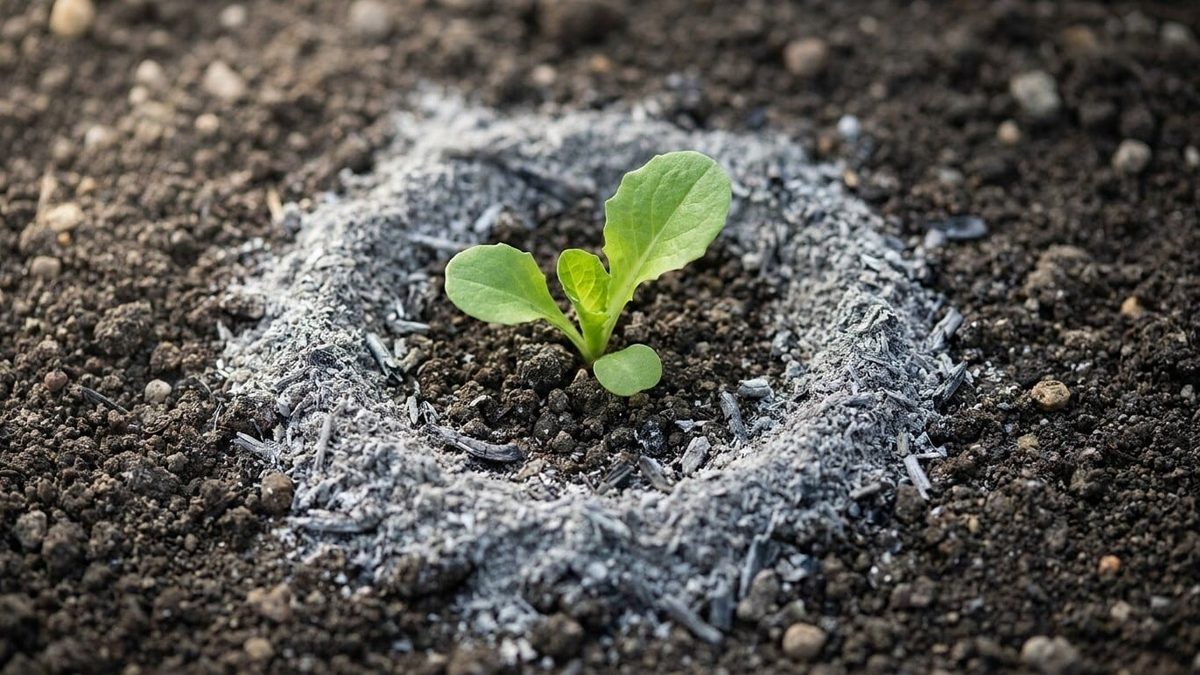
The morning will come. You looked down at the salad. There are holes everywhere. The silver marks in the soil tell the story. The slugs have struck again. This is a nightmare for any gardener who wants to clean, organic produce without resorting to blue pellets.
Old gardeners knew this. They forgot it. Now we are rediscovering it through costly failures. But there is a simple and ancient solution. A handful of wood ash. It works. Not by magic. Through chemistry and physics.
Why Slugs Love Your Salad Plants
The enemy is clear. It is the slug. Or the snail. They feed on young shoots. Lettuce, chard, spinach. A three-day-old transplant is a buffet for them. Soft. Wet. Defenseless.
Slugs thrive when the temperature rises above 10°C. They like moisture. Therefore, a wet spring is the worst time for seedlings. Snails are very active. They are hungry. And they are destroying your hard work.
Before pesticides and chemical traps, there was just observation. In the past, people burned wood in stoves and fireplaces and then stored the cooled ashes. They put it in a bucket. When it was time to plant the seeds, they walked in the garden. Thirty seconds per plant. They drew a gray circle around each seedling. They did not question the results. They just trusted the method.
The science behind the ash
Wood ash is not toxic. It does not kill on contact in the way a toxin does. It is a physical and chemical barrier. Two properties make it effective.
First, it is hygroscopic. Ash absorbs moisture. Snails use the mucus layer to move. You need water to glide. Dried ashes take them away. It destroys the mucus layer. Movement becomes painful and difficult.
Next is the pH value. Wood ash is highly alkaline. The pH can exceed 11, depending on the wood. This high pH can irritate the snail’s mucus and skin. Crossing the dry gray line is like crawling on wet sandpaper dipped in lye. Small slugs turn back. Leopard slugs and large snails usually turn immediately upon contact. They retreat.
But there is a catch. This barrier is fragile. Rain kills it. Even a light drizzle washes away the dryness. It neutralizes the pH. Wet ash is sticky. Slugs crawl right over it. This is why the old method required repetition. Not superstition. To observe. Reapply every time it rains.
The right way to spread ashes
Not all ash is safe. Do not use just any ash. It is necessary to use ash obtained from untreated wood. No varnished wood. No varnished wood. No particle board. No charcoal for grilling. These contain heavy metals and toxins. They belong in the landfill. Never get into the soil.
The ideal ash is obtained from household stoves. Oak or beech wood, burned cleanly. Sift it. Remove any large pieces. Fine ash works best. Improves adhesion to the soil. It creates a more uniform wall.
Be careful when applying.
- Plants: Lettuce, cabbage, zucchini, strawberries, seedlings.
- Create a circle: Draw a continuous ring around the plant. About a few centimeters wide.
- Timing: Valid at night. Snails are nocturnal. When they come out in search of food, they run into obstacles.
- Avoid direct contact: Do not place ash directly on stems or leaves. It can burn out.
Dosing and soil health
More is not necessarily better. Ash adds nutrients, but also raises the pH. Too much ash can make the soil too alkaline. This prevents the absorption of iron and manganese. Some plants do not like high pH. tomato. Potato. strawberry. Prefers slightly acidic soil.
Treat leftovers only once or twice a year. About 70-100 grams per square meter. That’s a handful. Enough to protect. Not enough to destabilize the soil.
The circle is very thin. Ash is fine, it’s raining. Apply again. This is also part of the rhythm of the garden. You can get healthy green and yellow vegetables cheaply. Small actions can connect you to the past.
Will Ash fail? sometimes. If the snail is desperate enough. However, for many it is an insurmountable obstacle. You see them turn around. You save the salad. currently.
The two tasks of wood ash
Gardeners who have returned to this ancient practice love it most for its practicality. Sure, it works as a slug repellent, but it also pours valuable minerals into the soil. It provides potassium, calcium and trace elements that promote crop health.
The chemical reaction is simple. Wood ash mainly contains potassium (5-10% K2O), lime (20-50% CaO), phosphorus (1-4% P2O5) and various trace elements. The ratio changes depending on what you burned. Hardwoods produce more ash than softwoods. So if you’re heating your home with wood this winter, you can now keep a natural fertilizer and a integrated repellent in the same stove.
Why it’s better than chemical alternatives
Wood ash is not a perfect solution. However, it can be a useful tool for gardeners who reject synthetic chemicals. Free if you have a fireplace or stove. In addition, beneficial insects such as ground beetles and hedgehogs are not at risk.
Compare this to metaldehyde pellets. It has been banned in France since 2020 because it is toxic to wildlife and pets. The ban leaves a void. Gardeners have filled this place with techniques their grandparents never abandoned. This change is not just about costs. This is all about the safety of animals sharing your garden.
When there is not enough wood ash
If your garden is full of slugs, ash will slow down the damage. The underlying problem is rarely solved. This often happens after a wet spring. The ash acts as a preventive and local protection. It does not work for eradication.
Combine this barrier with other natural practices to create a truly sustainable vegetable garden. Arrange shelters for hedgehogs and toads. Maintain the garden beds in your garden regularly. Choose varieties that are slug-resistant or simply aren’t slugs’ favorite food.
The ash ring is not an impenetrable barrier. This is your first line of defense.
How to apply and maintain
You need to renew the barrier every time it rains. The protection is focused on the most critical window. This is the first 3 weeks after the transplant. The Young plants have not yet developed strong outer leaves. They are still a ideal target.
Keep the ashes dry. Spread around the base of the plant. Avoid direct contact with stems if possible. However, once the roots are established, they usually tolerate alkalinity. Monitor after heavy showers. Reapply as needed to keep the circle intact. The goal is to create a hostile environment for the slugs without harming the soil biology or the creatures that eat them.


