You walk into a hardware store. The aisles are endless. One shelf holds miter saws. The next holds table saws. They look similar. They both cut wood. But choosing the wrong one will waste your money and your patience.
Here is the blunt truth. If you need to trim baseboards, get a miter saw. If you are building a cabinet or ripping plywood sheets, you need a table saw. Mixing them up leads to jagged edges and broken blades. Let’s break down exactly why.
Cutting Small Trim vs. Large Sheets
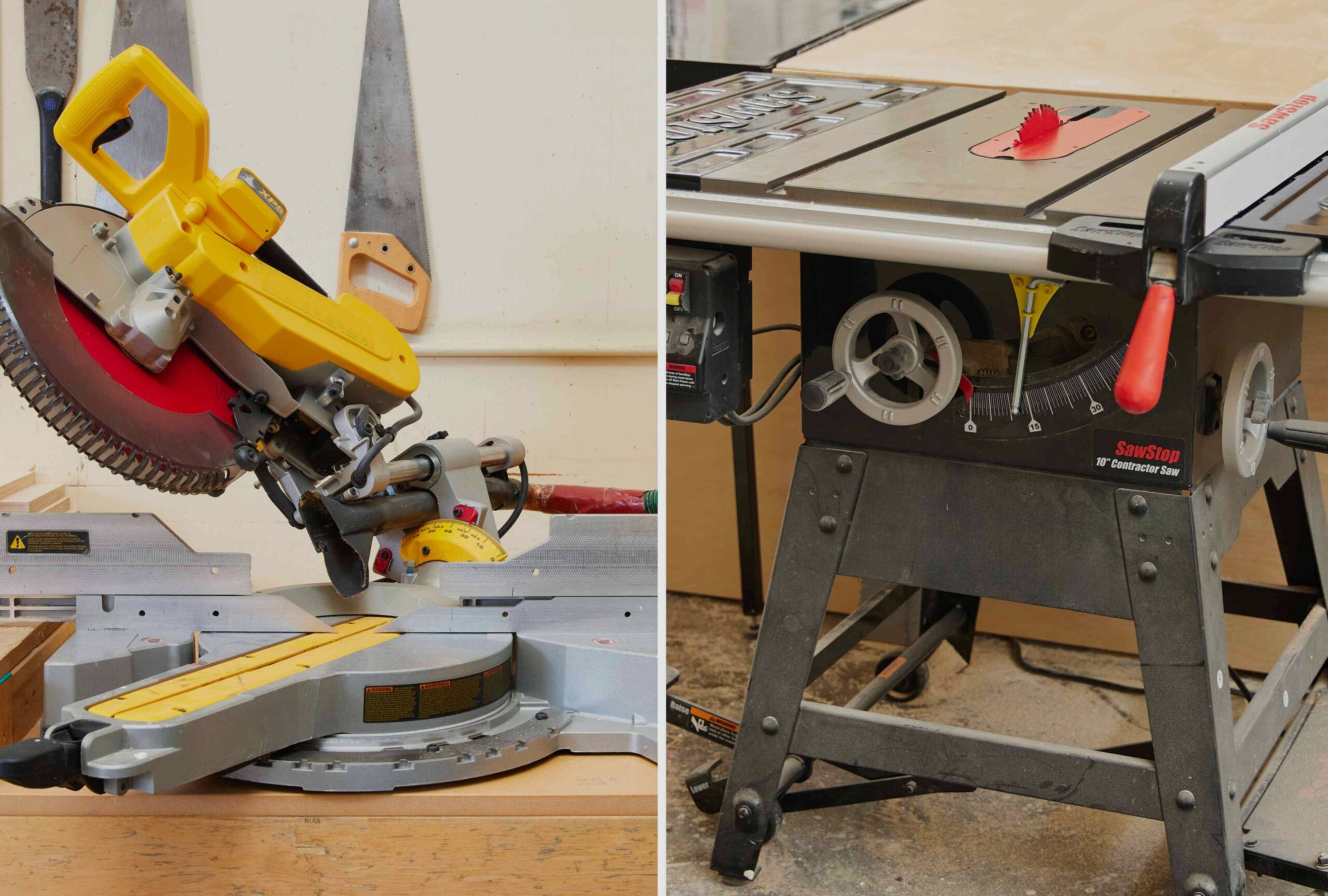
The biggest difference is material size. Miter saws have small bases. The blade drops down from above. It is designed for precision on small pieces. Think baseboard. Think crown molding. You set the angle, put the wood down, and pull the trigger. Simple.
Table saws are different. The blade sticks up from a large table. You push the wood through it. This setup handles long planks. It handles full sheets of plywood. You cannot fit a sheet of drywall or a 4×8 plywood sheet on a standard miter saw base. It won’t work. The table saw eats large materials whole.
Portability matters too. A miter saw weighs 30 to 40 pounds. You can toss it in your truck bed. You can carry it to a job site with one hand. A table saw? It weighs over 200 pounds. Even on wheels, you are moving furniture, not tools. For DIYers who travel to sites, the miter saw wins on convenience.
Why Accuracy Feels Different on Each
Accuracy is subjective. But there is a mechanical reason miter saws often feel more precise. On a miter saw, you lock the blade angle. You set the fence. The machine does the work. The wood stays still. The blade comes down. There is very little room for your hands to shake. The result is a clean, repeatable cut.
Table saws rely on you. You push the material through. If your push gets wobbly, your cut gets wobbly. The accuracy depends on your steady hand and your ability to keep the wood flat against the fence. You can improve this with a jig. You can use a sled. But without them, the margin for error is higher.
This is why miter saws are king for corner trim. That 45-degree angle needs to be perfect. A table saw can do it. But it takes skill and patience to get it right every time.
The Rip Cut Problem
This is the dealbreaker. If you don’t know what a rip cut is, you might buy the wrong tool.
A rip cut runs with the grain. Parallel to the length. A crosscut goes across the grain.
Miter saws are terrible for rip cuts. The blade orientation is wrong. You cannot safely rip lumber on a miter saw. It will kick back. It will bind. It might even shatter the blade. Don’t do it.
Table saws excel here. The blade spins vertically. The fence guides the wood parallel to the teeth. If you need to cut a wide board in half lengthwise, the table saw is your only real option. Always use the rip fence. Never freehand a rip cut on a table saw. That is how you lose fingers.
Crosscuts: Where the Miter Saw Shines
Crosscuts are cutting across the width. This is common. You have an 8-foot board. You need two 4-foot pieces. You need a clean cut. Fast.
The miter saw dominates here. You clamp the board. You set the blade. You drop it. Done. Repeat. The repeatability is unmatched.
You can crosscut on a table saw too. But it is awkward. You have to turn the board sideways. You have to use a crosscut sled for any real precision. Otherwise, you are just hoping you keep the line straight. For quick, repetitive crosscuts, the miter saw is superior.
Angled and Bevel Cuts
Woodworkers love angles. Sometimes you need a 90-degree cut. Sometimes you need 30 degrees. Sometimes you need a compound cut (angled and beveled at the same time).
The miter saw is named for this. It literally mits the angle. You swing the head left or right. You adjust the bevel. It is intuitive. Compound miter saws handle both simultaneously with ease.
Table saws can tilt for bevels. They can use the fence for angles. But the learning curve is steeper. Cutting bevels on a table saw requires careful setup. It is not as foolproof. If your projects involve a lot of complex joinery or angled frames, the miter saw offers a faster, safer path to the result.
Versatility vs. Cost
Table saws are more versatile. Technically, they can do rips, crosscuts, dados, and joinery with the right accessories. A miter saw is a specialist. It does crosscuts, miters, and bevels. It cannot rip. It cannot drill holes. It has limits.
But let’s talk price.
Miter saws range from $300 to $1,100 for quality models. You can get a decent compound miter saw for under $400.
Table saws? They start around $200 for a cheap contractor saw that might vibrate itself apart. Real, accurate table saws? That jumps to $800. Then $1,500. High-end cabinet saws run $5,000 and up.
If you are a beginner, the entry cost for a table saw is higher. The risk is higher. The footprint in your garage is bigger. The miter saw is the lower-risk entry point.
Which One Do You Need?
Start with the project. Are you building a deck? You need to rip boards. Get a table saw. Are you finishing a basement with trim? You need angles. Get a miter saw.
Many pros have both. They use the table saw for rough dimensions and the miter saw for final trims. If you can only buy one, ask yourself: what is the biggest piece of wood I will hold in my hands?
If it fits on the small platform of the miter saw, start there. It is forgiving. It is precise. It fits in your trunk.
If you are staring down a stack of plywood, you are already too late. Go with the table saw.
Or don’t. Just go buy both. Seriously. Space is expensive. Wood is cheaper.