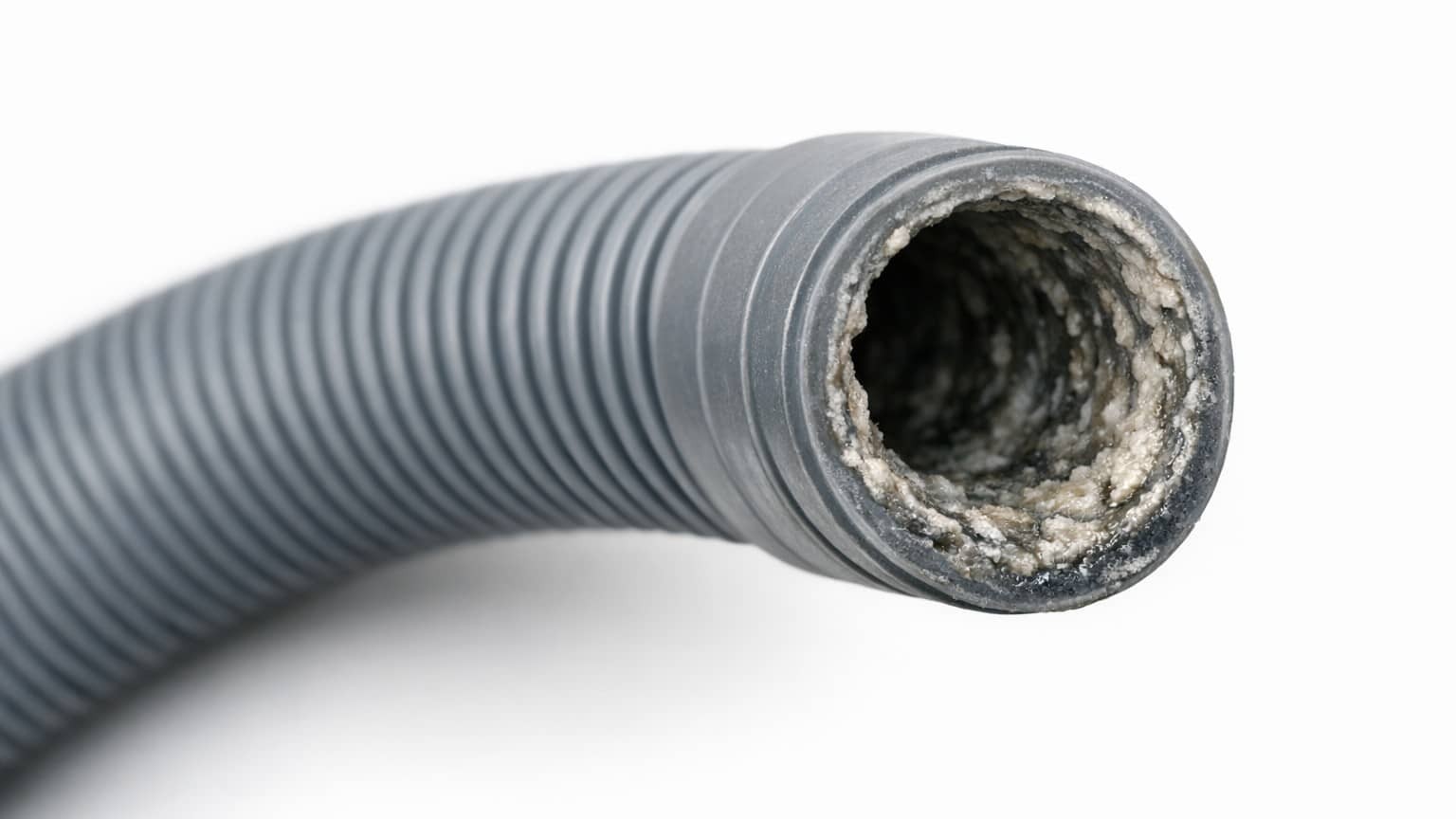
Behind your washing machine sits a flexible grey tube, usually 32 to 40 mm in diameter. It is roughly the size of a 1 euro coin. Every cycle, this pipe quietly pushes hundreds of liters of dirty water out of your home. Most owners have never cleaned it since the day they plugged the machine in.
That lack of attention creates a problem.
Biofilms build up silently. Your “clean” laundry may be passing through contaminated water without you knowing it.
What builds up inside the drain hose over years
With standard laundry routines, the drain hose quickly collects major deposits of grey, muddy sludge. This sludge is a mix of neutralized detergent, limescale, bacteria, mold, and general dirt. It is a cocktail that wants to stay still.
Constant humidity favors the growth of microorganisms. These create biofilms on the inside walls of the pipe. These are not cosmetic details. They are structured bacterial colonies. Water alone will not remove them. They re-contaminate your laundry every single cycle.
The residue often comes from poorly dissolved detergent, fabric softener, and dirt detached from clothes. Over time, these deposits form a greyish paste that sticks to the walls. Small fibers from clothes also detach during washing and form clumps in the pipe. You might find forgotten objects, coins, paper, or hair trapped inside.
Add hard water to the mix. It combines with soap residue to create hard concretions. These start out whitish but turn grey as they absorb dirt and particles from the wash water. The inside of the tube starts to look less like a conduit and more like a mini stalactite.
The problem does not stay in the pipe. A blockage can force grey residue back into the drum. The clothes you think are clean may have passed through water that touched this waste pile before flowing back up.
Signs your machine is struggling with a clogged hose
Watch for specific signs. Stagnant water. Unpleasant smells. Unusual noises during the spin cycle. Washing cycles that take abnormally long.
These signals have been present for weeks or even months. People often blame “aging machinery” or “bad detergent.” The real cause is usually banal and fixable.
A clogged filter disrupts the wash cycle in several ways. Persistent bad smells come from residues or a poorly maintained detergent drawer. Gurgling noises during drainage show the pump is working too hard due to obstruction. This repeated strain wears out the pump prematurely.
Replacing a pump costs between 50 and 150 euros. Cleaning the hose takes about 15 minutes.
Early warning signs include a noticeable drop in washing efficiency, persistent bad odors, and grey stains on freshly washed clothes. Grey stains on clothes coming out of the drum are the clearest sign. Your machine is washing your clothes in its own grime.
How to clean the drain hose and pump filter
Here is the good news. This is not surgery.
First, unplug the washing machine from the electrical outlet. Close the water supply valve. Pull the machine forward and move it to access the back. Locate the drain hose.
Remove the drain hose from the machine and from the wall drain. Be careful not to let water spill on the floor.
For cleaning the hose itself, two methods work.
- Fill a bucket with boiling water mixed with a packet of baking soda. Pour this mixture into the hose using a funnel. Wait a few minutes. Then pour plain water through the hose and check that it drains correctly.
- If deposits resist, use white vinegar. Mix two glasses of water with white vinegar. Bring this mixture to a boil. Pour it slowly into the drain hose.
For severe cases, like a hose blocked since installation, start with mechanical cleaning. Use a plumber’s snake or a brush. Follow this with a hot water rinse and a treatment using baking soda and white vinegar. You can find a plumber’s snake at any large hardware store for less than 10 euros.
Do not ignore the pump filter either. It is located at the bottom of the front facade of the appliance. Turn off and unplug the device. Place a low container under the trap. Loosen the plug gently to let residual water drain out. Then remove the filter completely.
Rinse the filter under clear water. Remove dirt and small trapped objects. Before replacing it, check that the pump impeller turns freely.
Repeat this operation every 3 to 4 months.
Monthly maintenance: the cheapest fix you can buy
Stop ignoring the monthly cycle. Run your washing machine empty at 60°C once a month. That’s it. The goal is to strip out detergent buildup and grime that clogs the drain hose over time.
Add a cup of white vinegar or soda crystals to the drum. It costs twenty cents. A new drain hose or pump repair costs hundreds. The math is brutal.
This is the single most profitable maintenance habit for your appliance.
Why using more detergent makes things worse
It feels logical, right? More clothes, more dirt, more soap. But that logic is backwards.
Oversizing your detergent dose creates sticky residue. That residue clings to the internal walls of the machine and the hose. It thickens. It traps lint. Eventually, it blocks flow.
Use less detergent. Paradoxically, this leaves your clothes cleaner and extends the life of your plumbing.
Change two habits immediately:
– Run hotter cycles regularly to kill bacteria and dissolve buildup.
– Leave the door ajar after every wash.
Moisture is the enemy. Mold sets up camp in a closed, damp drum. Airflow prevents it.
Add a lint filter to your drain line
If you want to go further, install an anti-lint filter on the drain hose. It acts as a physical barrier. It catches textile fibers and solid debris before they reach the pump or the external plumbing.
The cost is low: usually between 10 and 20 euros.
It is an invisible upgrade. You won’t see it working, but you will notice when your drain never clogs. It prolongs the life of the entire evacuation circuit.
Annual hose inspection: treat it like descaling a kettle
Once a year, disconnect and clean the drain hose.
Do not wait for the smell. Do not wait for the overflow. Do it as routine maintenance. Think of it the same way you think about descaling a kettle or changing air filters.
The washing machine handles the most water and dirt in your home. It deserves to be cleaned first.
If you skip this step, you are gambling against a small, preventable failure. The hose is the weak link in the system. Keep it clear, and the rest of the machine lasts longer.
“The machine that washes the most things in your home is often the one we clean the least.”