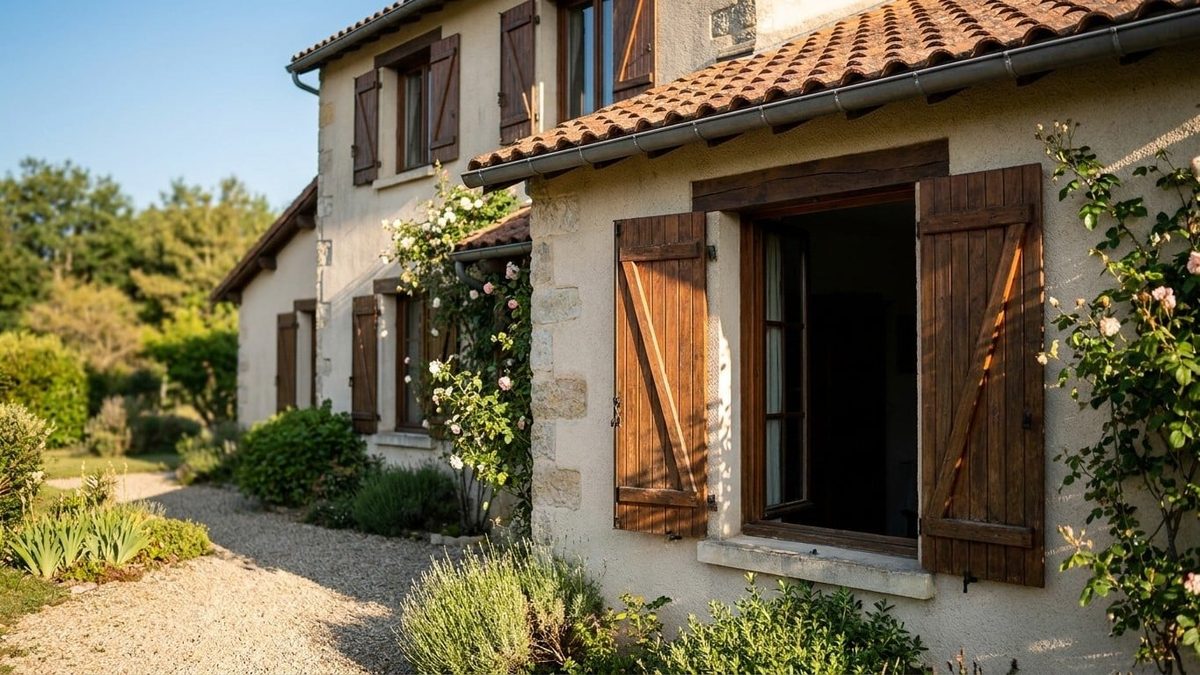
Leaving one or two shutters slightly ajar while the rest are closed isn’t an oversight. It’s a strategy. By deliberately leaving a window or shutter open during a three-week absence, that neighbor is unknowingly following a directive pounded into every household each summer by the gendarmes: a facade that is completely shut from top to bottom acts like a neon sign for burglars. The message is loud and clear: no one is home, and they will be gone for a while.
The idea feels counterintuitive. You instinctively think a barricaded house is a protected house. In reality, systematically closing all the shutters works as a far more reliable indicator of vacancy than a simply locked door. A burglar who spots a house where the shutters haven’t moved in days knows they can act calmly. They won’t risk running into an occupant. This is precisely the reflex the police are trying to break.
A moving facade creates doubt. For a thief looking to minimize risk and time on site, doubt weighs heavier than any sophisticated lock.
Why a frozen facade attracts professional eyes
Numbers back up this recommendation. In 2025, France recorded 212,000 declared burglaries. That is about 581 per day. 24 per hour. One every two minutes and thirty-five seconds. Contrary to the stereotypical image of a hooded thief striking at night, the reality is prosaic. 86% of burglaries happen in full daylight. Not at night. The most dangerous window is 2 PM to 6 PM. That four-hour block alone accounts for 43% of all break-ins. This aligns with another study showing 80% of burglaries occur during the week, with significant spikes between 2 PM and 5 PM. Times when occupants are most often absent.
Vacations amplify this phenomenon. Holiday periods, especially in summer and around Christmas, see a surge in offenses. These moments of prolonged absence allow criminals to act discreetly. Surveillance often happens days or even weeks in advance. A burglar preparing a job doesn’t just watch one night. They observe a street. They note habits. They look for weak signals. Closed shutters for several days in a row are one of those signals. So is a mailbox overflowing with flyers.
The feeling of insecurity isn’t limited to a handful of anxious people. Nearly a quarter (24%) of French citizens say they are strongly worried about burglary during their holidays. 54% admit to thinking about it. That is nearly 8 out of 10 people for whom it is a source of stress. This anxiety spikes for those who have already experienced a break-in. 91% fear burglary when they are away for long periods. It makes sense. Beyond stolen property, the intimacy of the home is violated.
What police really recommend for home security
The flagship measure remains Opération Tranquillité Vacances (OTV). It is free and available in every department. This police and gendarmerie service monitors your home during long absences and alerts you to anomalies. Surveillance is handled by patrols, day and night, weekdays and weekends. Registration is done online or directly at the station a few days before departure. This is not an obscure service. 26% of French people have used it. That proportion jumps to 32% for those living in individual houses.
Beyond this official monitoring, recommendations from law enforcement stress a often-neglected point: creating the illusion of presence rather than confirming absence. Police advise against posting vacation dates on social media or answering machines. Ask a trusted person to collect mail. A full mailbox signals a long absence. Logically, this means never leaving a spare key under the mat or in a flower pot. Even amateur thieves know this habit by heart.
The neighbor’s gesture of leaving two shutters open fits this logic of simulating life. A facade that moves slightly. A room lit by natural light. Someone who might appear at the window. It plants a seed of doubt in the mind of a rushed criminal.
How to simulate presence without being home
You don’t need to hire security for every vacation. Simple steps can mimic occupancy. Start with the mailbox. Empty it daily or ask a neighbor to pull it out. If you are gone for more than a week, ask a friend to pick up parcels.
Lighting is another easy tool. Use timers on lamps or smart plugs. Set them to turn on at different times each evening. This mimics the pattern of someone coming and going. Don’t set them on a rigid loop. Burglars spot repetitive patterns quickly.
Check your windows. Ensure curtains or blinds are not pulled back to reveal an empty room. If you are away for more than a few days, consider leaving one ground-floor window slightly open. Just a crack. It signals that someone lives there. It doesn’t have to be a wide-open door. A small opening is enough to create uncertainty.
Doubt is your best defense. A burglar wants certainty. Give them none.
Why timing matters for your security
Most break-ins happen when you are least likely to be home. Work hours. Afternoon naps. Weekend grocery runs. The 2 PM to 5 PM window is prime time. Criminals know this. They watch for houses where lights are off during these hours.
If you work from home, keep this in mind. Your routine might be different. But a criminal observing from the street sees only the exterior. They don’t see you typing at a desk. They see closed blinds. They see no movement.
Consider installing a visible security camera. Even a fake one can deter casual thieves. If you use a real camera, ensure it is pointed at the entrance. It records evidence and scares off opportunists.
Check your locks. Deadbolts should be Grade 1 or 2. Cheap locks are easy to kick in. Reinforce the strike plate with longer screws. This makes the door frame harder to breach.
Common mistakes homeowners make
Posting vacation photos on social media in real-time is a huge error. It confirms your absence to the world. Wait until you are back to post.
Leaving a radio or TV on can help. But don’t rely on it alone. It can sound robotic if set on a loop. Mix it with movement.
Don’t forget the backyard. Overgrown bushes can hide a burglar. Trim them back. Install motion-sensor lights in the garden. They startle intruders and draw attention.
Check your shed. Store expensive tools and equipment out of sight. Or better yet, lock them up. A visible lawnmower or power tool can signal that there is valuable property inside the house.
A visible threat is better than an invisible one. Make your home look defended.
The psychology of the burglar
Most burglars are opportunists. They want the easiest target. They don’t want a fight. They don’t want to be seen. They want to go in, grab what they can, and leave in under three minutes.
A house that looks occupied is a hard target. A house with open shutters, lights on in the evening, and a car in the driveway is a risky target. You don’t need to be home to make it risky. You just need to create the illusion.
This illusion starts with small details. The mail. The curtains. The lights. The neighbor who knows to check on you. It is a collective effort. Build a network of trusted people. Tell them when you are away. Ask them to report anything unusual.
What to do if you suspect a break-in
If you come home to a forced entry, do not go inside. Your safety is more important than any stolen item. Call the police from a safe distance. Preserve the scene. Do not touch anything. Wait for the officers to arrive.
Document everything. Take photos of the damage. List what was taken. This helps with insurance claims and police investigations.
Change your locks immediately. Even if the door wasn’t broken, the thief might have a copy of the key. Or they might have picked the lock. Assume the security is compromised.
Review your security measures. What went wrong? Was the camera disabled? Was the alarm not set? Learn from the incident. Strengthen your defenses for next time.
Prevention is cheaper than replacement. Invest in security now.
Building a security habit
Subtle cues that break the pattern
Sensors are great. But human habits work too.
You don’t need a $300 smart system to throw off a pro.
Set a timer for a bedside lamp. It flickers on at 8 PM. Every night.
Ask a neighbor to pull your car out of the driveway once a week. Not every day. Just occasionally.
Have mail held. Or forwarded to your vacation address.
These small details matter.
A burglar scans a house for patterns.
Silence. Stillness. Consistency.
Break the pattern.
“One lamp. One car move. One forwarded letter. It’s not about being obvious. It’s about being unsure.”
Make them guess.
Uncertainty costs time.
Time costs money.
Burglars want in and out. Fast.
They avoid homes that look watched. Even if no one is watching.
The goal isn’t to look occupied.
The goal is to look possibly occupied.
Why digital silence matters more than you think
Here’s where most people fail.
They post their vacation photos.
Caption: “So relaxing! Two weeks of pure bliss. #Bali #Offline”
Do you know who sees that?
Thieves.
They scroll. They search. They wait.
Your post is a free alarm system. For them.
It says: “Empty house. High-value items likely inside. No one around for fourteen days.”
Don’t give them the blueprint.
Wait until you’re back.
Post the sunset. Post the food. Post the selfie.
But not while you’re gone.
The data shows a shift.
Only 18% of active social media users still post their departure plans.
That means 82% have changed their habits.
Police campaigns work.
Slowly.
But they work.
Stop broadcasting your absence.
Keep your feed quiet.
Let your photos be about the past, not the present absence.
Location changes everything
Not all houses are equal.
A suburban home.
A rural farmhouse.
A city apartment.
Each has different risks.
2025 crime trends show a national dip.
But look closer.
Rural and peri-urban areas?
Crime is rising.
Why?
Less surveillance.
Fewer neighbors.
Longer response times.
An isolated farmhouse is vulnerable.
A city apartment with neighbors on every floor? Less so.
People notice things.
They hear footsteps.
They see strange cars.
Proximity is security.
Adapt your strategy.
If you’re in the country, rely on timers. Rely on neighbors. Rely on strong locks.
If you’re in the city, rely on building security. Rely on visible cameras. Rely on community awareness.
One size does not fit all.
Know your environment.
Then protect it accordingly.
Sources: smoke-defender.com | interieur.gouv.fr