There is nothing more frustrating than a door that refuses to cooperate every day. You are standing there, bracing your shoulder against the wood and pushing with all your might just to get inside your own home. To make matters worse, the bottom edge of the door drags across the wooden floor every time you close it. You can hear a scratching sound. You can see the damage. Your patience is running out.
You don’t need to hire a carpenter. The whole frame does not need to be replaced. In most cases, a stuck or scratched door is just a minor alignment issue that can be fixed with a few simple adjustments. Before you rip off a Revit hinge or sand down several inches of wood, check out these five practical fixes. It’s cheap, fast and won’t hurt your shoulders.
Check the hinges first
Most sticking doors are not actually out of square. It’s just loose. The screws that attach the hinge plate to the door frame can loosen over time from repeated opening and closing. In this case, the door will sag slightly. This looseness can cause the latch to get stuck or the bottom edge to drag against the floor.
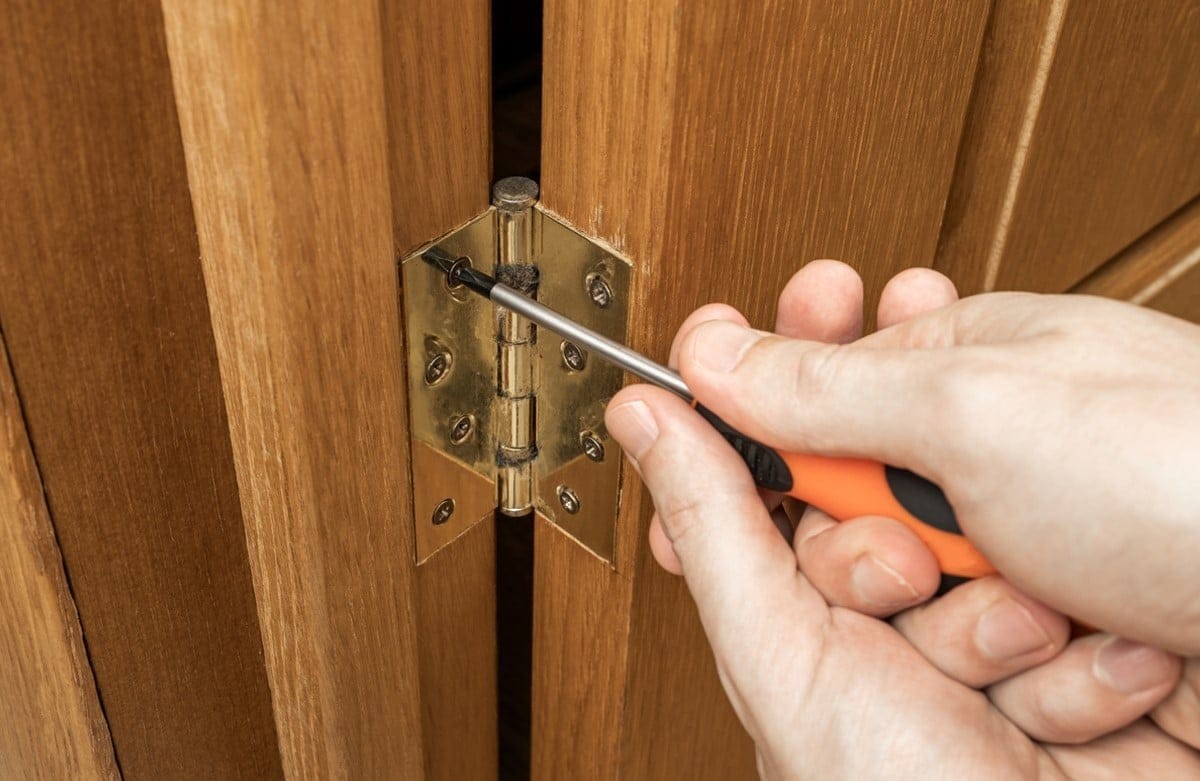
Get a driver. Tighten the screws of the hinge plate and strike plate. If the screw rotates freely in the wood, it has lost its grip. These holes must be filled. For permanent fixing, you can use wooden dowels or wood glue. For a quick hack, insert a toothpick or crumpled paper into the hole, add a dab of wood glue, snap the toothpicks off and reattach the long screw. The screw now bites into something solid.
Adjust the Hinge Barbs
If the sagging does not stop after tightening the screws, there may be a problem with the hinge itself. Most interior and exterior door hinges have a small metal barb or fin in the knuckle. This barb penetrates the wood of the door frame and secures the hinge. If it is not fully embedded, the door will sag.
Take a hammer and a nail set (or a small punch). Place the tip of the punch against the barb on each hinge. Use a gentle but firm tap to push the barb all the way into the frame. Do this for the top and middle hinges. This usually gives the door enough height to clear the door frame and floor. It’s a small adjustment, but it makes a big difference in how smoothly the door moves.
Shim the Door Frame
The frame itself may be slightly skewed. This is common in older homes where the foundation has settled or newer homes that haven’t completely dried out yet. If the door rubs the side of the door frame from above and below, the gap will remain uneven.
Look at the gap between the door and the door frame. If the top is wider than the bottom, the frame is skewed. This problem can be solved by adding shims on the hinge side. Loosen the hinge screws. Slide a piece of thin cardboard, matches or a purpose-made shim behind the hinge plate on the side of the frame. Tighten the screws. This will press the door frame slightly and realigning the door. Let’s check the swing again. If it’s still stuck, move it to the latch side. You may need to loosen the strike plate and shim behind it to make more room for the latch.
You can’t solve what you don’t understand. Before you pick up a screwdriver, you need to find the real problem. If the door does not lock, it does not necessarily mean that there is a problem with the hinges. Sometimes it’s weight. It can be deformed.
Look at the symptoms. They will tell you exactly where to look.
If the door pulls against the floor, it is not the correct height. If it rubs against the frame on the sides, the lateral adjustment is incorrect. If you feel the pull coming in, the problem is with the latch alignment (deportance).
First, find out what the problem is. It will save you hours of frustration later.
Prepare the tools
Don’t start blindly. Gather your gear. A sturdy ladder is necessary to reach the high hinges. You will also need:
- the right screwdriver
- Hex key set
- tape measure
- bubble level
・Metal spacer (washer)
If you have a PVC door, look for the stop screws. Usually they are hidden inside the hinge. When you know the location of the screws before you start, you won’t be in a hurry to stripping threads.
Fixing interior door height
Interior doors are relatively simple. Over time it tends to sag as gravity gets the better of it. The hinge is dented a few millimeters. that’s it. But those few millimeters are enough to scratch the floor.
The repairs are mechanical. You have to adjust the hinge yourself.
When the door is open, lift it slightly. This activates adjustment mechanism. be careful. Interior doors can weigh up to 20 kg. Don’t drop it on your foot.
After the door is supported or removed, turn the hinge mechanism with a screwdriver.
The exact steps for dragging door are:
- Tighten the top hinge one full turn.
- Loosen the bottom hinge one full turn.
- Hold the center hinge.
Rehang the door. Check the clearance. It should slide without friction.
If the adjustment is not sufficient
Sometimes hinges alone don’t save the day. The door may swell due to moisture. Maybe you just installed a thicker floor.
There are two paths left.
Plane the door. Remove wood until it fits. This is permanent. Requires sharp tools and patience.
**Add spacers. ** Place the metal washers inside the hinge cup. This allows you to raise the door slightly without cutting the wood. It is less invasive. It’s easy to reverse if you make a mistake.
In either case, the door may need to be removed to ensure proper operation.
Adjust the front door
The front door is heavier. They are also more complex. Accuracy is key here. If the front door is oriented incorrectly, it affects safety and insulation.
The front door has three different adjustments. Height. Lateral alignment. and lock depth.
Adjust the height of the front door
Look at the hinge. The adjustment screw is usually hidden behind a small cover. Pop them off.
Insert the hex key. Turning clockwise raises the door. Turn counter-clockwise. Go slow Just a quarter turn makes a noticeable difference.
Lateral Alignment
If the door is stuck on one side, you may have to move the entire frame to align it.
Remove the hinge cover. Locate the lateral adjustment screw. Place the bubble level above the door. Adjust the screws until the door is perfectly plumb.
Note that changing the lateral alignment may affect the height. We recommend that you check the height adjustment again after this step. It’s a balancing act.
Fixing the Latch Depth (Deportance)
This is what most people miss the most. If air is trapped or the latch is not locked evenly, the air will deportance.
Place the adjustment screw on the opposite side of the height adjuster. Turn it with the hex key. The door should move enough for the latch to lock completely without binding.
Try it. Open and close. lock and unlock.
It is done when it feels like it has solid. If not, adjust again. Small adjustments. Big results.